
games like Krillion
Games Like Krillion: 9 Daily Trivia & Guessing Games
The best games like Krillion: Connections, Globle, Wordle, Fermi, Worldle, Songless and more — what each daily game plays like, how it differs, and which to try first.

Games Like Krillion: 9 Daily Trivia & Guessing Games
If Krillion hooked you, the games like Krillion listed below will too: they share its DNA of a short daily challenge, a clear goal, and a reason to come back tomorrow. The closest matches are Connections (daily categorization), Globle (daily country deduction) and Fermi (daily estimation), with Wordle, WorldLE, Songless and a few classics covering the rest of the daily-puzzle family. Every game here is free to play in a browser and takes ten minutes or less.
About this guide: Krillion Wiki is a fan site, not affiliated with krillion.io. Game details are based on publicly available information — daily games update often, so check each official site for the current rules.
The quick list: games similar to Krillion
| Game | Daily format | Closest to Krillion because |
|---|---|---|
| Connections | Group 16 words into 4 sets | Open knowledge, daily misdirection |
| Globle | Guess the hidden country | Geography recall, deduction loop |
| Wordle | Guess a 5-letter word | The shared daily-ritual blueprint |
| Fermi | 3 estimation questions | Rare-answer energy, but with numbers |
| WorldLE | Guess a country from its outline | Geography practice between dives |
| Songless | Guess the song from a snippet | Limited-attempts daily guessing |
| Daily trivia quizzes | Timed general-knowledge sets | Same recall-under-pressure feel |
| Mini crosswords | 5×5 word grid | Fast daily word workout |
| Sudoku | Number logic grid | The original daily discipline |
Full breakdowns below — including the two games that could not be more different from Krillion while still scratching the same itch.
1. Krillion itself: what makes it hard to replace
Before the alternatives, it helps to name what Krillion actually is. Each daily Dive gives every player the same seven open prompts — 25 seconds each, one typed answer — and the rarity scoring rewards answers fewer players give. "Mountain bike" is correct; "penny-farthing" is correct and deep. No other daily game scores originality directly, which is why the closest substitutes all trade away some part of that formula: their answers are fixed (Wordle, Globle), their scoring is binary (Connections), or their competition is the clock (trivia quizzes).
The practical takeaway: pick an alternative for the habit you want — deduction, words, music, numbers — and treat Krillion as the scored main event. Our Krillion vs Wordle, Krillion vs Connections and Krillion vs Globle comparisons go deeper on the two-game matchups.
2. Connections: grouping knowledge in new ways
Connections, from The New York Times, deals sixteen words and asks you to find the four hidden groups of four — with four mistakes allowed and a difficulty color (yellow through purple) attached to each group. Where Krillion generates answers, Connections hides structure: the puzzle is engineered so plausible near-groups tempt you, and the purple group usually turns on wordplay.
Why Krillion players enjoy it: the misdirection. Both games punish the obvious first instinct — in Krillion the crowd's obvious answer scores shallow, in Connections the obvious grouping is usually the trap. Our Krillion vs Connections comparison covers the matchup in detail.
3. Globle: a daily hidden-country hunt
Globle picks one mystery country per day. You type any country, it colors in on a world globe with a temperature reading — hotter means closer to the answer — and you triangulate with unlimited guesses until you isolate it. No timer, no score, no turn limit; just deduction.
Why Krillion players enjoy it: geography is one of Krillion's recurring prompt families, and Globle drills the same mental atlas from a different angle. Krillion asks "name a country with a Y in it" and scores your originality; Globle asks "which country am I hiding?" and scores nothing at all. See Krillion vs Globle for the full breakdown — and if geography is your weak prompt family, the Passport Ready theme pack trains it directly.
4. Wordle: the original daily word ritual
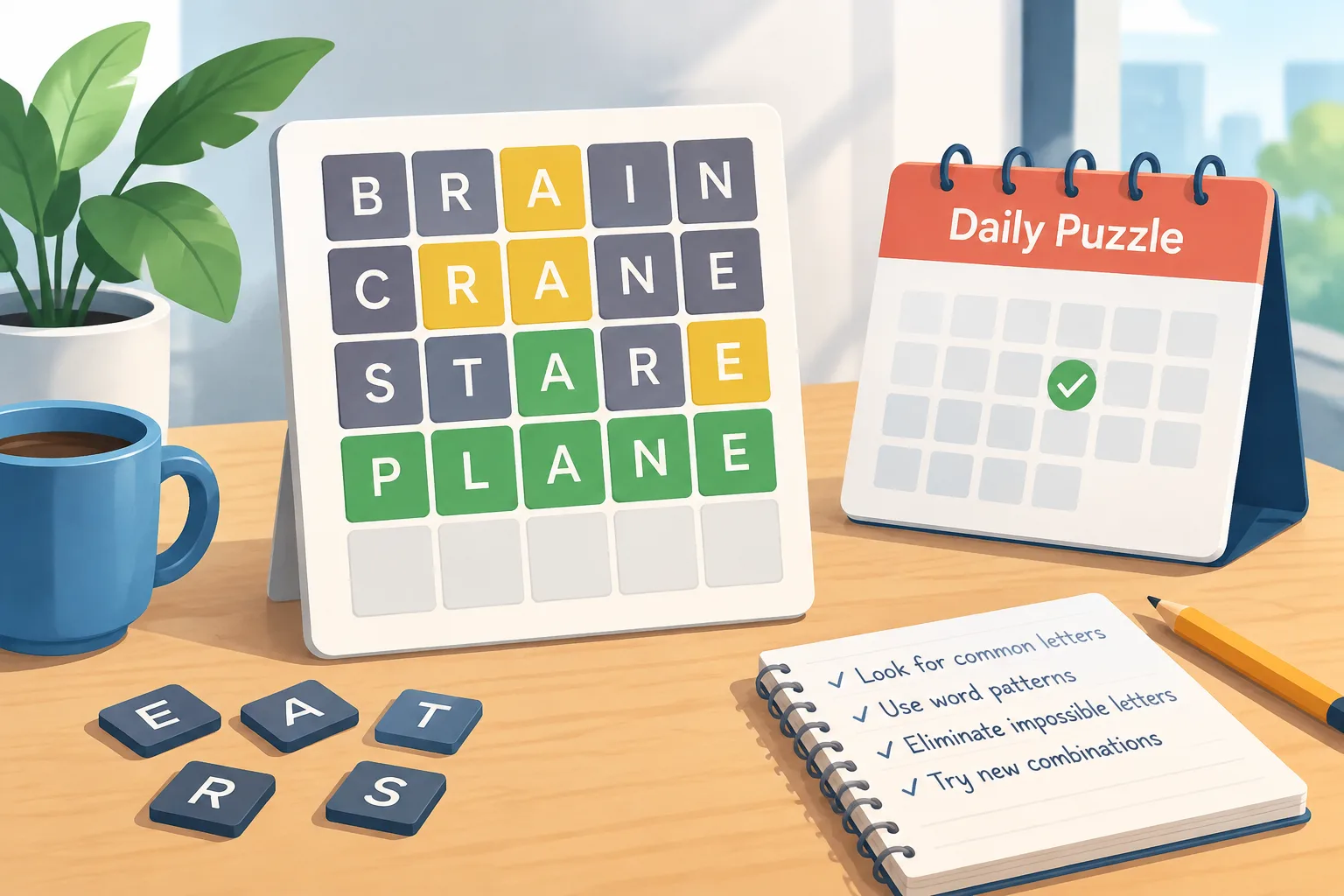
Wordle needs little introduction: six attempts to find a five-letter word, with green/yellow/gray feedback after each guess, one puzzle per day. It established the modern daily-game blueprint Krillion follows — a shared puzzle, a shareable result, a midnight-cadence habit.
Why Krillion players enjoy it: the shared-daily tension and the post-puzzle comparison. The differences are just as instructive: Wordle's answer is fixed for everyone while Krillion's "best answer" is defined by what the crowd types, and Wordle has no timer while every Krillion prompt runs a 25-second clock. More on this in Krillion vs Wordle.
5. Fermi: daily estimation in three questions
Fermi (fermi.gg) asks three impossible questions a day — "how many piano tuners in Chicago?" energy — one guess each, scored on how close you land to the true figure. New puzzle daily, free, minutes long.
Why Krillion players enjoy it: it's the same "trust your first instinct at your peril" workout with numbers instead of words. Fermi's scoring is absolute (closeness to reality) where Krillion's is relative (rarity against the crowd), which makes them perfect complements — our Krillion vs Fermi comparison explains the contrast.
6. WorldLE: guess the country from its outline
WorldLE shows a country's silhouette each day; you guess the name, and wrong guesses come back with a distance and arrow pointing toward the target. It's Globle's cousin with a visual twist — map shape instead of globe proximity.
Why Krillion players enjoy it: the same "I know this... almost" recall scratch, and it's the gentlest game on this list — a good palate cleanser between dives. If world geography is where your daily scores leak, both WorldLE and Globle make cheap daily practice, and the prompt categories guide shows where geography sits in the rotation.
7. Songless: name that tune with limited attempts
Songless is the music entry in the daily family: you hear a snippet of a song and guess its title, with more of the track revealed over a limited number of attempts. It runs on the same once-a-day loop as everything else here.
Why Krillion players enjoy it: it swaps general knowledge for a single domain — music — and keeps the "how few hints do you need?" scoring tension. If a music-themed daily sounds like your lane, note that Krillion's own catalog is expanding the same direction: the official packs page lists a Music theme pack as coming soon.
8. Daily trivia and quiz games
Beyond single-mechanic daily games, there's the broader world of daily trivia: newspaper quiz apps, pub-quiz-style apps with a daily board, and timed general-knowledge sets. These are the closest to Krillion's content — broad general knowledge under time pressure — and the furthest from its scoring: they grade you on correct versus incorrect, not on how rare your correct answer was.
Why Krillion players enjoy them: volume. If seven prompts a day isn't enough trivia, daily quizzes stack. The trade-off is the loss of Krillion's signature idea — that the best answer is the unusual one. To bring some of that back, study what "rare" looked like on past days in the answer library.
9. Mini crosswords and the classics
Two evergreens round out the list. Mini crosswords (five-by-five, a couple of minutes, one per day) deliver the fastest daily word workout and pair naturally with a morning dive. Sudoku drops knowledge entirely for pure logic — the daily discipline without the trivia.
Why Krillion players enjoy them: consistency and pacing. Neither competes with Krillion's content, but both reinforce the daily-puzzle habit — and the mini crossword's "finish fast, share your time" ritual is the same social glue as Krillion's percentile screen.
How should you choose a game like Krillion?
Every game like Krillion trades away a different part of the formula. Our recommendations, matched to what you actually like about the game:
Match the substitute to what you actually like about Krillion:
- You like the scoring. Nothing scores originality like Krillion does; the closest competitive feel comes from percentiles in daily quizzes. Keep Krillion as your scored game and treat everything else as practice — tips to beat your score is the training manual.
- You like the deduction. Globle, Connections and WorldLE all hand you incomplete information and reward careful inference.
- You like the breadth. Daily trivia quizzes cover the widest surface of general knowledge; Fermi covers the deepest single question.
- You like the ritual. Wordle, mini crosswords and Sudoku are the backbone of a multi-game morning rotation — all shareable, all daily, all free.
And if what you like is Krillion itself but more of it: the theme packs add thirty-chapter drills per domain, and the archive reopens past dives.
Frequently asked questions about games like Krillion
Are there games exactly like Krillion? No exact copy exists in the daily space. Connections, Globle and Fermi each cover part of the formula, but Krillion's rarity scoring — where unusual-but-correct answers earn the most points — is unique. What is the closest type of game? Daily general-knowledge games: Connections for puzzle-style play, timed trivia quizzes for the recall-under-pressure feel. The complete answers live in the FAQ block below, alongside the dedicated comparisons: Krillion vs Wordle, Krillion vs Connections, Krillion vs Globle and Krillion vs Fermi.
Keep exploring daily puzzle games
However you rotate them, all of these games reward the same habit Krillion does: showing up tomorrow. Between dives, the score calculator and answer library are the fastest way to turn today's result into tomorrow's improvement — and the wiki hub has the full guide index when you want to go deeper on packs, unlimited mode, scoring or the daily reset.
FAQ
Are there games exactly like Krillion?
No exact copy exists in the daily space. Connections, Globle and Fermi each cover part of the formula — daily rhythm, open knowledge, rare-answer tension — but rarity scoring that rewards unusual-but-correct answers is unique to Krillion.
What is the closest type of game to Krillion?
Daily general-knowledge games. Connections is the closest puzzle-style match, while timed daily trivia quizzes match the recall-under-pressure feel — though they score right versus wrong instead of rare versus common.
Are Wordle and Krillion the same type of game?
They share the daily shared-puzzle blueprint, but the skills differ: Wordle is one fixed five-letter word with letter feedback, while Krillion is seven open prompts scored on how uncommon your answers are.
Do puzzle strategies guarantee better scores in Krillion?
No — rarity depends on what everyone else types that day, so nothing is guaranteed. Studying past answer sheets, managing the 25-second clock and drilling weak categories reliably improve your odds.
Where can I find more Krillion guides?
The Krillion Wiki hub indexes every guide across basics, scoring, modes and games-like, plus the free score calculator and the searchable answer library of past dives.