
daily games
Daily Games: Daily Guessing Games and Daily Puzzle Games Worth Your Routine
A player-first guide to daily games, including daily guessing games, daily puzzle games, and daily word games. Learn how to build a routine, avoid burnout, and find games like Krillion.
Daily Games: Daily Guessing Games and Daily Puzzle Games Worth Your Routine
Daily games are short, scheduled challenges that reset on a regular cycle, usually once a day. They include daily guessing games, daily puzzle games, and daily word games. The appeal is simple: one bounded attempt, a shared rhythm with other players, and a clear result you can compare without committing to an endless grind.
What Are Daily Games?
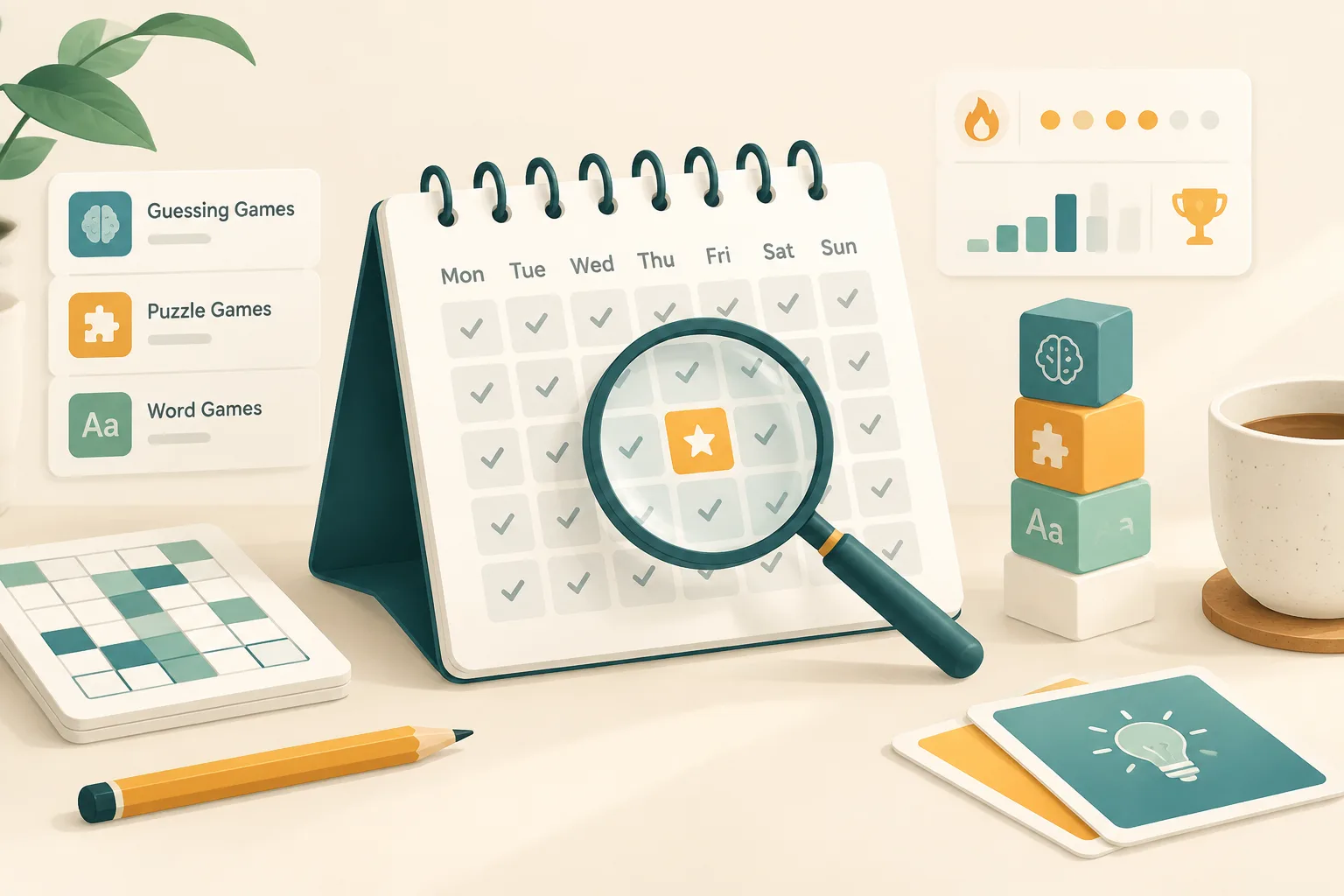
Daily games are repeatable puzzles or guessing challenges with a fixed reset schedule. A typical daily game gives you one official attempt per day, then asks you to wait for the next cycle. Some add streaks, rarity scores, leaderboards, or unlimited practice modes, but the core loop stays small: read, guess, submit, learn.
The category is broad. Daily guessing games can be trivia, number, image, or word based. Daily puzzle games might be logic grids, crosswords, or spatial challenges. Daily word games usually ask you to find or arrange letters. What ties them together is the schedule, not the genre.
Why Do Daily Guessing Games Fit a Routine So Well?
Daily guessing games fit a routine because they have a fixed start and end point. You do not decide when to stop; the game stops for you. That makes them easy to attach to an existing habit, such as coffee, a commute, or lunch.
The shared daily reset also creates a low-pressure social ritual. Everyone who plays is working from the same puzzle, so discussion stays focused. A practical example: if you play three daily games, group them into one ten-minute block instead of checking them separately throughout the day. You reduce context switching, and you get a clean finish. If a game offers an unlimited mode, keep it separate from your daily block so practice does not blur into obligation.
How Do Daily Puzzle Games Differ from Endless Puzzle Apps?
Daily puzzle games are built around scarcity. You get a limited set of attempts or a single puzzle, then the door closes until the next reset. Endless puzzle apps are built around availability, so you can play as many levels as you want.
That difference matters for your routine. If you want a five-minute habit, choose a daily puzzle game. If you want a long weekend session, choose an endless mode. Many games offer both, which is why reading the mode labels matters. Check whether a mode is ranked, casual, or practice before you treat its score as comparable.
What Makes a Daily Word Game Worth Playing?
A daily word game is worth playing when its rules are clear, its feedback is honest, and its daily limit respects your time. The best examples teach you something after a loss: a new word, a better opening pattern, or a reminder about letter frequency.
Wordle is the widely known reference point. Its public format is one puzzle per day, six guesses, and color-coded feedback. That structure is easy to understand, which is why so many daily word games borrow parts of it. When you evaluate a new one, ask three questions: How many guesses do I get? Is the answer drawn from a known list? Does the game explain its feedback? If the answer to any of those is unclear, treat the game as experimental until you verify the rules.
Where Does Krillion Fit in the Daily Games Landscape?
Krillion is described on this fan wiki as a daily rare-answer trivia game. The Krillion Wiki is independent and not affiliated with the creators of Krillion (krillion.io), so this page separates what the wiki documents from what players speculate about. Its public coverage areas are listed below.
The wiki's public knowledge domains include Daily Dive, Rarity Scoring, Packs, Unlimited Mode, Leaderboards, and Answer Reveal Archive. Those domains describe coverage areas, not a guaranteed ruleset for every version of the game. If you are coming from Wordle-style daily word games, the shift is from letter placement to answer rarity and trivia recall. For a direct comparison, see Krillion vs Wordle. If you want a broader list of alternatives, see games like Krillion. And if you are unsure when the next cycle begins, check what time does Krillion reset.
How Can You Build a Daily Games Routine Without Burnout?
Build your daily games routine around a time box, not a game count. Pick one anchor habit you already do, attach the games to it, and stop when the box ends. A ten-minute box is enough for most daily guessing games and daily puzzle games.
If you add a new game, remove one or move it to a weekend-only slot. The goal is a routine you can keep on a busy day, not a perfect streak. Keep a simple log if you play competitive modes. Note the game, the date, your result, and one lesson. That log turns a string of isolated puzzles into feedback you can use. When a game introduces a new mode or scoring change, treat older notes as historical, not current. Daily games are live products, so mechanics can change between versions.
Verified Mechanics vs. Community Strategy in Daily Games
Verified mechanics are rules that the game itself states or that the wiki can confirm from a reliable source. Community strategy is advice from players, and it may be useful without being official. Mixing the two is the fastest way to get frustrated.
Verified baseline examples:
- Wordle-style daily word games commonly give one puzzle per day and a fixed number of guesses, usually six, with color feedback.
- Daily games often reset at a specific time in a specific time zone, so the date on your device may not match the game's cycle date.
- Streaks usually track consecutive completed daily attempts, not unlimited practice sessions.
Community strategy examples, labeled unverified:
- Opening with a particular word because it covers common letters.
- Saving a guess for a specific category or rarity tier.
- Trying to predict an answer trend from previous days.
- Assuming a scoring formula is stable across updates.
None of those community ideas are guaranteed. Test them in a practice mode when one exists, and do not treat a single good result as proof. For Krillion specifically, use the Krillion score calculator to explore how known values affect a score, and use the answer library to review past reveals. Those tools help you study patterns without claiming that a pattern will repeat.
What Are Common Daily Games Mistakes?
A common mistake is treating a daily game like an endless game. If you keep replaying in your head after the daily attempt is over, the format stops doing its job. Another mistake is chasing a streak after the fun has gone.
A streak is a record, not a contract. If a game starts to feel like an obligation, reduce the number of dailies or move the competitive ones to a less busy part of your week. A third mistake is ignoring the reset time. Many daily games use a fixed server reset, so playing late at night can create confusion about which puzzle you are solving. Check the game's own reset documentation when possible. On this wiki, the relevant page is what time does Krillion reset.
FAQ
What is the difference between daily games and daily guessing games?
Daily games is the broad category: any scheduled puzzle or challenge that resets on a cycle. Daily guessing games are a subset where the core action is guessing, such as a word, number, image, or trivia answer. A daily guessing game is a daily game, but not every daily game is a guessing game.
Are daily puzzle games free?
Many daily puzzle games are free to play in a browser or app, often supported by ads or an optional subscription. Some competitive or unlimited modes may require payment. Always check the current mode labels and store listing before assuming a daily game is fully free, because access can change between versions.
What are the best games like Krillion?
Games like Krillion usually combine a daily reset with trivia, rarity, or guessing mechanics. Look for a daily challenge, a clear answer reveal, and a scoring system you can review. This wiki's games like Krillion page lists alternatives for players who want a similar daily loop.
How do daily word games keep streaks fair?
Daily word games usually define a streak as consecutive completed daily puzzles. Miss a day and the streak may reset, but unlimited practice should not count. Fairness depends on clear reset rules and consistent puzzle availability. If a game changes its reset time or answer list, read the patch notes before judging a broken streak.
Can I play daily games without spoilers?
Yes, but it takes small habits. Solve your daily games before opening social feeds, mute hashtags or channel names tied to the game, and use an answer archive only after you have made your official attempt. On this wiki, the answer library is best used for study and review, not for spoiling an active daily puzzle.
Build a Better Daily Games Habit
The best daily games are the ones that fit your real day. Choose a small set, anchor them to an existing habit, and separate verified rules from community theories. If you play Krillion, start with the mechanics you can confirm, then use tools to study your results without turning a five-minute ritual into a second job.
Ready to check your score or review past answers? Try the Krillion score calculator for a quick scoring check, then browse the answer library when you want to study patterns. Both tools are part of the Krillion Wiki toolkit.